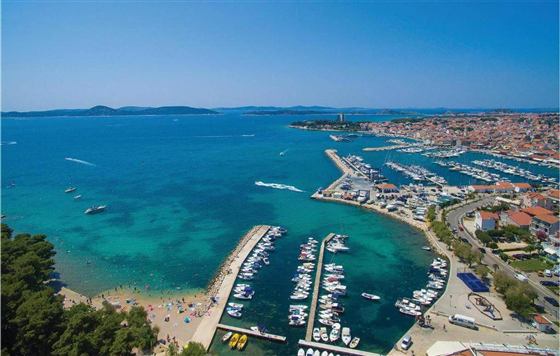
Split has Diocletian and Zadar has its Roman forum — but Šibenik belongs to the Croats alone. Unlike almost every other city on this coast, it was not founded by Greeks or Romans: it is the oldest native Croatian town on the Adriatic, first mentioned in 1066 in a charter of King Petar Krešimir IV. That independent streak still shows. Šibenik feels lived-in rather than staged, a working city draped over a steep hillside above one of the most beautiful natural harbours in the Mediterranean. And from PRIKA Pool House it is an easy 25 km — about 30 minutes by car.
The Cathedral of St James — a miracle in stone
Start at the reason Šibenik is on the UNESCO World Heritage list: the Cathedral of St James (sv. Jakov). Built between 1431 and 1536, it is made entirely of stone — no wood, no brick, not even in the barrel vault and dome — a feat of engineering its two master builders, Juraj Dalmatinac and Nikola Firentinac, achieved with interlocking stone slabs nobody had attempted at that scale before. Walk around the outside of the apses and you'll meet the cathedral's most beloved detail: a frieze of 71 stone heads, portraits of ordinary citizens of the 15th century — sceptical, amused, weary, wonderfully human. Look for your favourite; everyone finds one.
Four fortresses, one glittering channel
Šibenik defended itself for centuries, and the result is a ring of four fortresses:
- St Michael's Fortress — crowning the old town, now an open-air concert stage with a sea view that steals the show from most performers.
- Barone Fortress — restored, panoramic and the local favourite for sunset, when the rooftops and the channel below turn copper.
- St John's Fortress — the highest of the hilltop three, also beautifully restored, with the widest panorama of city, islands and hinterland.
- St Nicholas' Fortress — a 16th-century sea fortress guarding the entrance of the St Anthony Channel, itself UNESCO-listed; it sits on an islet and is visited by boat.
The Šibenik channel that these forts protect is a sight in its own right: the sea threads through a narrow, cliff-lined passage before opening into the bay, and watching yachts glide through it from the ramparts is half the pleasure of the climb.
Practical information
- Distance from PRIKA Pool House25 km · about 30 min by car
- Parkingwaterfront garages fill by mid-morning in summer — arrive early or come for the evening
- Ticketscathedral + fortress combo tickets exist — check the official sites before you go
- Time neededhalf day for the highlights · full day at an easy pace
- Best light for photoslate afternoon, when the stone glows gold
The old town: marble, monks and Braavos
Between cathedral and fortresses lies a labyrinth of marble alleys, stairways and hidden squares. On the main square, opposite the cathedral, stands the elegant town loggia from the era of the Republic of Venice, which ruled the city for centuries. Fans of Game of Thrones will recognise more than they expect: Šibenik stood in for Braavos, and several scenes were filmed on the cathedral steps and in the surrounding lanes. For a quieter moment, slip into the medieval monastery garden of St Lawrence, a restored Mediterranean garden of lavender, herbs and citrus tucked behind monastery walls.
How to do it like a local
Make it a half day — or a slow evening. Šibenik works beautifully as a morning trip: park by the waterfront early, do the cathedral and one fortress, and be back at your private pool for the hot afternoon hours. Even better in July and August: drive in around 17:00 when the day-trippers leave, watch the sunset from Barone, have dinner in a konoba in the back lanes — the family-run ones a street or two above the riva are usually the best value — grab a gelato on the waterfront, and you're still home in 30 minutes, to total silence.
Combine it with Krka. The entrance to Krka National Park is only about 15 minutes from Šibenik, so a waterfall morning and a cathedral afternoon make a perfect full day. Or pair the city with a lazy swim: our guide to the best beaches around Vodice has plenty of spots on the way home.
And when you've had your fill of city stone, the region flips the script: spend a day among the 89 islands of the Kornati archipelago, or head inland to the watermills and fortresses of the Dalmatian hinterland — where the crowds never follow.